Washington and the Parade of Sail 😊
Updated: Jul 4
Between leaving the Oosterschelde in Norfolk and joining her again for the Parade of Sail, Sheila and I had a ten day stretch in the US. We worked our way back from the Capitol and Trump's birthday cage-fight and controversial painting of the reflection pool, to Williamsburg and Yorktown in Virginia, the place where independence was won from the British. What we hadn’t given much thought to was the World Cup Football, which was screened everywhere in parks and food malls and was the hottest topic of conversation😊

First of all, we stayed with Sheila’s lovely friends, Katharina and Harald, in Fairfax, on the edge of Washington. This great American diner was a sweet change of ambiance and a chance to meet Katharina, Harald and Anna, their daughter. And we also took time to visit the Capitol, as well as Mount Vernon, where Washington retired to and managed a progressive farm and a huge distillery!


At the Capitol, it was hot and some of the visitors were already wiped out … but we hung on in there and did the full tour and joined the public gallery for both the Senate and Congress (lots of small issues and not many present – I counted 18 in Congress and 3 in the Senate). The architecture, paintings and statues are impressive. Washington holds court in the ceiling frieze and there’s a trompe l’oeil narrative of American history around the whole rotunda. I liked the fact that 2 statues are nominated by each state: there is a fabulous mix of people and issues celebrated, including Rosa Parkes, Chief Standing Bear from Nebraska and General John Sevier from Tennessee, “a hero of King’s Mountain”.


And, of course, there was an original printing of the Declaration of Independence.

The Capitol was tremendously open – citizens roamed quite freely inside – and even claimed the gardens for their yoga sessions!


The National Mall, between the Lincoln Memorial and the Capitol, is lined with Smithsonian museums of all flavours. My great friend Kristen had suggested the Museum of African American History and Culture and I’d surely recommend to you all. It starts on the lowest floor with ships carrying enslaved people from Africa – and finishes with dazzling contemporary art and culture on the top floor. So much to understand, like the African Queen who tried to defend her people against the Portuguese (who traded more enslaved people than any other country and twice as many as the UK); the shocking experience of Africans transported to the US and sold into plantation life; evolving up through fighting for Washington in the War of Independence, Jim Crow, Segregation and the Klu Klux Klan. With precious freedom for some, along the way. I hadn’t realised that New York had more enslaved residents than any other city in North America, with 43% of households depending on enslaved domestic servants and labourers. It’s so absorbingly presented that I hardly took any photos and you definitely need time to take it all in.


The Capitol was very much George Washington’s legacy and I was glad to visit Mount Vernon, the home he retired to from public life, after winning the War of Independence

He chose the most amazing location on the banks of the Potomac, with land where he could explore progressive ideas in farming. Look out for the sixteen sided barn and the Ospreys perched on the channel marker in the river. And I took a photo especially for Patricia, who doesn’t like the idea of camping – but might be impressed by Washington’s glamping and his wonderful, collapsible travelling four poster bed! It turns out that his teeth and false teeth were terrible, which is why he never smiles in portraits!. But his uniform and HQ flag are distinctive!


The little Mount Vernon pigs are for Jo, who loved them in Bahamas, and I’ve included the lego model, for Charlie!


And the locally brewed beer made me smile, given that the second rule of civility says “when in Company put not your hands to any part of the Body not usually discovered” 😊


After a little wander about the house, we escaped from the heat into a lovely restaurant in the west wing, with iconic murals of Mount Vernon around the walls.

This last picture, below, looks across to the conservatory which was converted into quarters for enslaved field hands. Interesting to find out that Washington gave all his enslaved people their freedom, when he died, but his wife, Martha, came from plantation stock and did not deliver on Washington’s promise.

Near Mount Vernon is Alexandria. It’s also on the Potomac and several tall ships were supporting the Jazz festival and lining up for the parade of sail later in the week (see the figurehead with sunglasses!) and we found a great story about pineapples. According to legend, the pineapple is a symbol of hospitality and when a ship returned from sea, the captain would spear a pineapple on his fence post outside his home to let his friends know of his safe return and to invite them to visit, share his food and drink and listen to tales of his voyage. I might try to do the same in Notting Hill and see if people know what I’m trying to say 😊 😊 😊


We had amazing food at a restaurant just called Ada after Ada Lovelace and so there are some pictures for Jo, in honour of the Ada Lovelace school in West London. Amazingly, the non-alcoholic cocktails were purple, like the uniform at the William Perkin school where Jo teaches! There was a pretty sunset before a thunderstorm came in and blew away our table and umbrella in a flash!


Before going back to Norfolk, we had a weekend with Katharina in a pretty beach house in Cape Charles. A very cool place with great beaches, shops and cafes. We loved it and found all kinds of new wildlife, including mole crabs (good bait, we’re told), ghost crabs and horseshoe crabs! Looking west, the sun set across the sea from the beach and it was wonderful to swim into the sunset, through all the sparkles and reflections.


The pace of life in Cape Charles was heavenly and revived us for our last few days based in Norfolk. Highlights there were the re-enactment settlements at Williamsburg and Yorktown; the Great Dismal Swamp, Virginia Beach and the Outer Banks, in North Carolina. We got there by the amazing Chesapeake bridge (first picture below). There are several tunnels along the way, so that shipping can pass through, over the tunnel. Taken together, the bridge and its tunnels are 17.6 miles - longer than the distance from Notting Hill to Heathrow airport!!

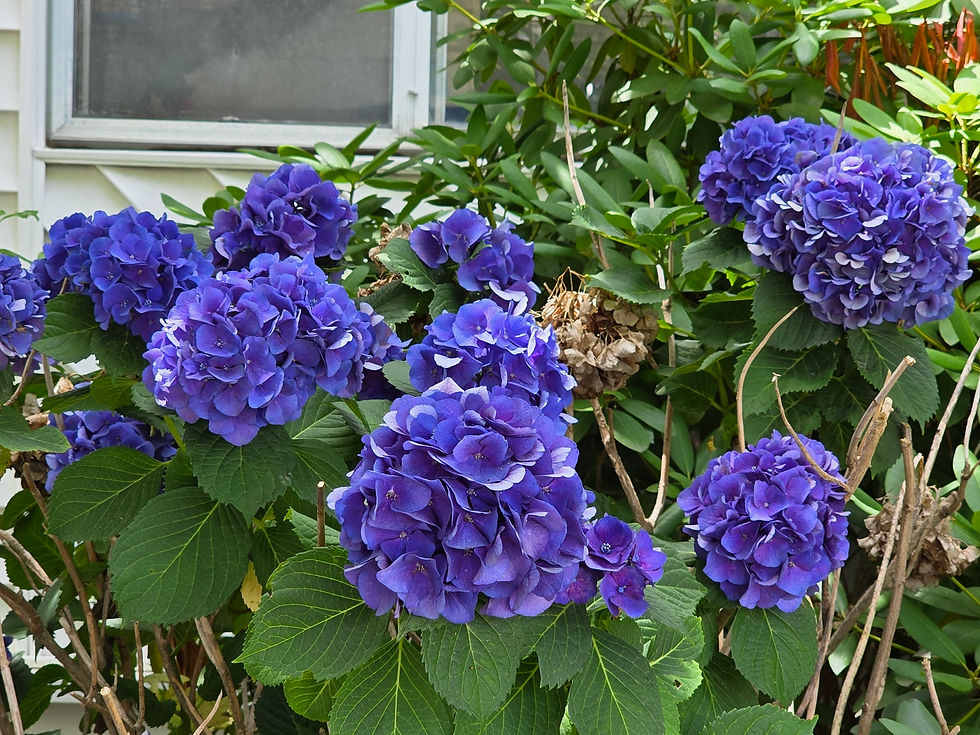
Back in Norfolk, we fell in love with porches and verandas again - and the colour of Virginia hydrangeas ...

Our beach house was a stone’s throw from the sea at Ocean View and just along from the longest fishing pier in North America! Whole families fish together in the evenings, catching mostly spot and greenbacks!


And we had another gorgeous sunset...


Colonial Williamsburg is a historic district in a city which was capital of the Virginia colony in the crucial 18th century. Fire has been a real enemy for the original buildings, some of which have burned down several times. But it’s been beautifully rebuilt and is a living history museum where actors in period costume share what life was like in the courts, stores, workshops and streets, all those years ago. Here’s the Capitol building, which had a “House of Burgesses”, so I had to include an explanation for my friend Sally Burgess!


Sheila is holding the Grand Union Flag, or Continental Union Flag, which features the Union Jack and the thirteen stripes for the colonies and was the de facto flag of the United States from its adoption in 1775 until June 1777. For us, there were very few folk about and it was a good time to be visiting…. We met the wigmakers, dressmakers, shoemakers and many more...


I loved the Stamp Act protest - against the English but on the most English of things – a teapot! The Governor’s Palace served as the official residence for the royal governors of the colony of Virginia and felt very like an English historic house – except for the fact that the oil paintings needed to be protected by silk gauze, to protect the painting from mosquitoes which get stuck to the oil paint, softened and sticky in the sun!


A secret success for me was to catch up with General Washington. He had run away from me in Mount Vernon, in a hurry to some more important engagement. But he had time to chat in Yorktown ….


On the way down to Jamestown and Yorktown, to see the places where the decisive battles where held, it was a treat to see the Oosterschelde again, slipping back down the James River from Richmond, for the festival in Norfolk…

We came across Patrick Henry in Yorktown – Founding Father and Governor of Virginia – famous for his 1775 speech “Give me liberty or give me death”. Like Washington, he stepped out of public life to look after his wife and their amalgamated family of 17 children!

The encampment in Yorktown included the Doctor and his tent; the musketeer (who made Sheila jump out of her skin by firing unexpectedly); the armourer; the farmer and his cat Rochambeau, named after the French general who played a decisive role in securing independence for America.


The farms were interesting too – the white farmer’s small holding with all the crops native to America – such as tobacco (first picture below) - and the enslaved people’s plot which brought many African plants to the US, including peanuts (who knew they grow underground?)


Like the sunflowers, everything in America is huge. We were amazed by Magnolia trees sixty feet tall with equally grand flowers.

Away from the farm, just trotting around the old town, we saw all these birds (the Northern Cardinal was fabulous) and met a family of roe deer, which seem quite common in this area….


There was even more wildlife in the Great Dismal Swamp, which we toured with an American Indian naturalist Penny Lazauskas. In earlier days, this swamp played a key role in the Underground Railway which supported escaping enslaved people fleeing to freedom in the North. Today, though, we saw a black bear eating blackberries and evidence of tree damage caused by bears. Then turtles again – this time painted turtles – beautiful butterflies – a praying mantis (you have to look hard to see it, since it's green against the green leaves) and a ground hog, which I didn’t catch a photo of, along with hundreds of medicinally important plants growing everywhere and either side of a beaver track …..


The turkey vultures were everywhere and it was good to identify the swarms of raptors we saw rising with the air warmed by the tarmac of the I64 west, the main road back from Williamsburg!
We did a little detour home – on empty roads – to see the Outer Banks – famous for peaches and beaches and, also, the place where the Wright brothers flew their first plane, at Kitty Hawk: 12 seconds that changed the world! It was December 1903 when Orville Wright made the world’s first controlled, powered, heavier-than-air flight!


Virginia Beach was on the way home. A Guiness Book of Records world record holder for the longest recreational beach in the world, at 35 miles! It’s also very elegant and has memorable statues, like this huge one of Neptune. The only slight puzzle in the posh hotel, the Cavalier, were the surreal paintings in the reception room. You need to look twice at the detail …


There was a great beachside restaurant, Buoy 44, where we could watch the Tall Ships gathering for the Parade of Sail.


So the final chapter of our journey links the last blog and this one. We stayed to watch the Oosterschelde sail into Norfolk in place of honour in the parade of sail and were lucky enough to be out on the water in The American Rover, which was also participating and gave us a ship-to-ship view of the great tall ships and some of their smaller companions. Connor, from the American Rover, was a great companion, full of little stories about the boats. He shared this website where you can look up any of the 30 Tall Ships and 30 accompanying vessels in the parade: https://sail250virginia.com/. Go to the menu and look at ships and if you click on any of them you get their photo and details …..


The day started cloudy and threatened rain – but everything brightened till the festival in the afternoon when there was music, fabulous foods like Funnel Cakes (imagine a doughnut which looks like a tangled ball of wool) and also the fireworks! Here are some shots of the Norfolk shipyard – the largest Naval shipyard in the world. The catamaran is used to launch marines and the commentary said it could reach 50 knots – five times as fast as the Oosterschelde top speed!


I particularly like this osprey aircraft which can fold up its wings for vertical take off and landing!

The Parade of Sail was led by the Eagle, managed by the US Coastguards and one of the “four sisters” built in Nazi Germany but claimed as part of the reparations at the end of the war and now sailed by the US, Portugal, Romania and Germany as sail training barques. There are lots of stories about them having swastika door handles and taps in the captain’s cabin, but I don’t know if that’s true.


The Oosterschelde was in pride of place next, after Peru’s BAP Union, the largest ship in the parade, along with a huge range of vessels from the US, South America and Europe. The only one which could claim English heritage was a replica of the Godspeed, one of the ships which first brought English settlers to Virginia in the early 17th century. It’s of a generation of tillers, before steering wheels, and is half the size of the Oosterschelde and a quarter of the size of The Eagle – carrying only 50 people, as against 230 in the Eagle.


Of the smaller vessels, I loved the sail-powered tug, and the yacht with a flag larger than its sail – and, of course, the proud kayak!


The ships slipped into the harbour, showcasing their cadets and lining up for the tug to bring them alongside. (not all have a bow-thruster, which gives the Oosterschelde such manoeuvreability)


The ships lined the piers and quays alongside the festival at Waterside park and we had a chance to go round these historic vessels. But I suspect you’ve had enough of ships by now – so I will focus on the harbourside party (Sister Sledge and Patti Labelle), the football, Juneteenth celebrations and the fireworks, which closed the day in style.


Just along from the park is the Nauticus museum with the massive battleship Wisconsin moored up alongside. In the museum park, I met a team working with students in Virginia with the Micro:bit and the MakeCode platform - and that completely made my day - it is 10-11 years since we launched that project and it is still used by millions of students every week. See: Micro:bit Educational Foundation | micro:bit. Lovely also to see the channel markers, Sheila's favourites; the Norfolk mermaid and the roof ridge figures on the pagoda, which provide spiritual protection for the building, as we walked the waterfront.


Exhausted by the end of the day, we escaped to a rooftop party to watch the fireworks - it was fantastic to be up high!

The Ecuadorian ship had mast lights to match its huge flag 😊😊😊


I loved Sheila photobombing the Admiral and her attache whilst we waited for the fireworks – yes, a lady Admiral!


And I’ve borrowed a picture from the Richmond sailfest to finish with – where they magically projected a tall ship into the sky 😊 😊 😊

And as a little PS – here is one of my cats, Archie, possessing my kit bag as I try to unpack. Almost as if he is saying “enough – no more travelling for a bit, now that you are home” 😊 😊 😊


Just make sure you have that pieapple the right way up, upside down signifies something different!